Story · Folklore & the Fort
Umar and Marvi: Sindh’s great romance, set in Umerkot Fort
In the tale of Umar and Marvi, a Soomra ruler imprisoned a shepherd girl in Umerkot Fort and begged her to marry him — and she refused, choosing her desert home over a crown. That refusal became the most beloved story of Sindhi courage, sung for centuries in Shah Abdul Latif Bhittai’s Shah Jo Risalo.
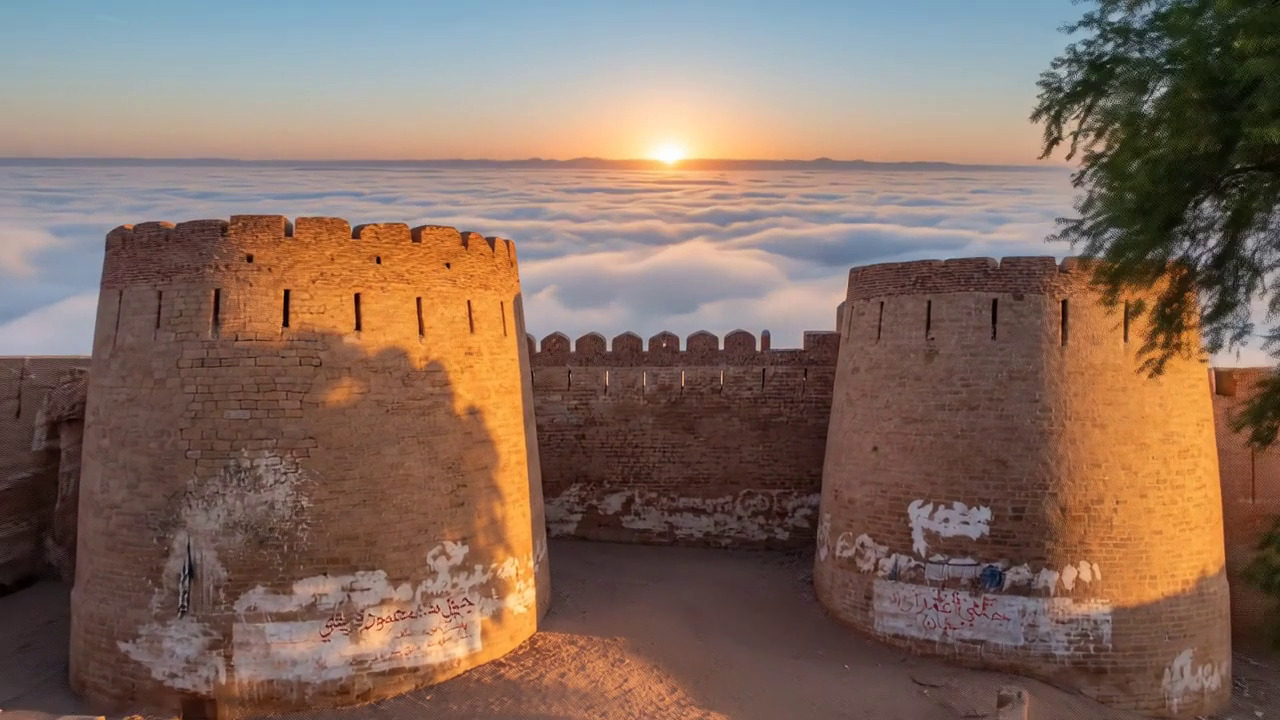
Understanding the tale of Umar and Marvi
The story is set in and around Umerkot in the era of the Soomra dynasty. Umar, the ruler of the fort — the same Umer whose name the city carries — saw Marvi, a shepherd girl of the desert, and resolved to make her his queen. He brought her to Umerkot Fort and held her there, offering her every comfort a ruler could give. Marvi answered with a refusal that Sindh has never forgotten: she wanted no palace, no jewels, no king — only the sand, the well, and the people of her village.
In most tellings she languishes for years — seven, in the classic version — while her family and village grieve. She pines for the desert itself: the camels, the thorns, the freedom of an open horizon. Eventually Umar, moved or defeated by her constancy, lets her go, and she walks home to her people.
Why Marvi means so much to Sindh
Marvi is not remembered as a victim but as a heroine of refusal. Where other tales celebrate conquest and marriage, Marvi celebrates denial — the power of a poor girl to say no to a king. Shah Abdul Latif Bhittai, Sindh’s greatest Sufi poet (1689–1752), gave her the most tender chapter of his Shah Jo Risalo: the Sur (musical mode) of Marvi. In Bhittai’s telling, Marvi’s longing for her homeland becomes an allegory of the soul’s longing for its true home — and her refusal of worldly power becomes a spiritual lesson in detachment.
Over the centuries Marvi grew into something larger than folklore: a symbol of Sindhi identity, self-respect and resistance to coercion. Her name is sung at weddings, recited in poetry, and painted on the walls of the region she refused to leave. For many Sindhis, loving Marvi is loving Sindh itself.
The fort as a character
The tale binds the history of Umerkot Fort to Sindhi culture in a way no inscription could. The fort is thus famous twice over: as the birthplace of Emperor Akbar in 1542, and as the prison that could not hold Marvi’s will. UNESCO’s Tentative List submission for the fort points to exactly this double inheritance, describing the site as “a unique blend of folklore, desert resilience, and living heritage.”
Frequently asked questions
What is the story of Umar and Marvi?
Umar, the Soomra ruler of Umerkot, imprisoned the shepherd girl Marvi in his fort, hoping to marry her. She refused every offer, pined for her desert village, and was finally allowed to go home — her defiance becoming the great Sindhi symbol of courage and loyalty to one’s roots.
Where did the story of Marvi take place?
The tale is set at and around Umerkot Fort in Sindh, in the era of the Soomra dynasty (11th–13th centuries).
Who wrote the story of Marvi?
The story was sung most famously by Shah Abdul Latif Bhittai in his Shah Jo Risalo, where Marvi has her own chapter (Sur Marvi). The tale itself is older folk tradition.
Why is Marvi important in Sindh?
Marvi is a heroine of refusal — a poor shepherd girl who rejected a king. She has become a symbol of Sindhi identity, self-respect and love of homeland.
Was Umar and Marvi a true story?
It is a legend rooted in the real history of Umerkot and the Soomra dynasty, kept alive for centuries by oral tradition and Bhittai’s poetry. Its setting — the fort — is real and still stands.
Sources
Hear the fort’s two stories — Akbar and Marvi — told frame by frame.
Watch the cinematic experience