Story · Akbar & Umerkot
Akbar the Great was born at Umerkot Fort, 1542
Emperor Akbar the Great — known across the subcontinent as Akbar Badshah or Akbar-e-Azam — was born at Umerkot Fort in Sindh on 15 October 1542. His father Humayun, the second Mughal emperor, was a fugitive that winter, sheltered by the Rajput ruler Rana Prasad Sodha inside a desert fort that history had been preparing for exactly this moment.
Understanding Akbar’s birth at Umerkot
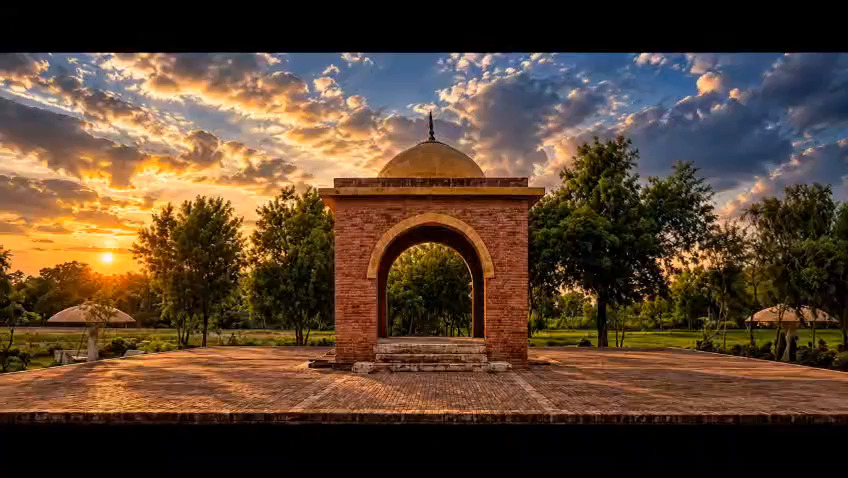
Akbar’s full name was Jalal-ud-din Muhammad Akbar, born to Hamida Banu Begum, the wife of the Mughal emperor Humayun. His birthplace is one of the few royal birthplaces in the subcontinent that can be named with certainty, because it was so unusual: not a palace, but a mud-and-brick Rajput fort at the edge of the Thar Desert, where a defeated emperor had taken refuge. UNESCO’s Tentative List submission for Umerkot Fort records the site precisely, and a small pavilion within the fort — known locally as Akbar’s Tomb — marks the traditionally believed spot of the birth.
How the emperor came to be born in a desert fort
Humayun’s flight from Sher Shah Suri
In 1539–1540, Humayun lost his throne to the Afghan general Sher Shah Suri. Pursued across Hindustan, the emperor retreated towards Sindh with his household, crossing the Thar Desert with an army reduced to a shadow of itself. By 1542 he had reached the Sodha-ruled territory of Amarkot — today’s Umerkot.
Refuge with Rana Prasad Sodha
The ruler of Amarkot, Rana Prasad Sodha of the Rajput Sodha clan, took the fallen emperor in — a decision of remarkable generosity, since sheltering a fugitive monarch risked Sher Shah’s wrath. It is within this refuge that Hamida Banu Begum gave birth to her son on 15 October 1542.
From refugee’s son to the greatest Mughal
The child born in hiding would never meet his father’s defeat. Crowned in 1556 at Kalanaur, aged thirteen, after Humayun’s sudden death, the boy grew into the third Mughal emperor and the architect of the empire’s golden age — reigning from 1556 until his death in 1605 over a state that stretched across most of the subcontinent.
What made Akbar’s reign remarkable
Akbar inherited a fractured realm and built one of the largest empires the subcontinent had seen. He is remembered above all for the policy he called sulh-i-kul — “universal peace” — an official doctrine of religious tolerance that abolished the special tax on non-Muslims and drew Hindu Rajputs into the highest ranks of his court, often through marriage alliances. His court at Fatehpur Sikri hosted theologians of every faith, and the spiritual order he founded, the Din-i-Ilahi, remains one of the most studied experiments in religious pluralism.
His patronage created a cultural golden age: the great Persian miniature painting schools, the translation of the Hindu epics into Persian, and architecture that still defines Mughal taste. When he died on 27 October 1605, his son Jahangir built him the famous tomb at Sikandra, near Agra — the monument of his death. Umerkot remains the monument of his birth.
Frequently asked questions
Where was Akbar born?
Akbar the Great was born at Umerkot Fort, in what is now Umerkot District, Sindh, Pakistan. A pavilion inside the fort — called Akbar’s Tomb — marks the traditionally believed site.
When was Akbar born?
Akbar was born on 15 October 1542, during the reign of his father Humayun — who was in exile at the time.
Why was Akbar born in Umerkot?
Humayun was fleeing the armies of Sher Shah Suri and took refuge with Rana Prasad Sodha, the Rajput ruler of Amarkot (Umerkot). Akbar was born during that refuge.
Is Akbar buried at Umerkot?
No. Akbar died in 1605 and his tomb is at Sikandra, near Agra, built by his son Jahangir. The pavilion at Umerkot commemorates his birth, not his burial.
Who is Akbar Badshah?
Akbar Badshah (“Emperor Akbar”) is how the third Mughal emperor is remembered across Pakistan, India and the wider subcontinent — Akbar-e-Azam, Akbar the Great, born at Umerkot on 15 October 1542.
Who was Akbar’s father?
Akbar’s father was Humayun, the second Mughal emperor and the son of Babur. Humayun was a fugitive in exile when Akbar was born at Umerkot Fort in 1542.
What is Akbar’s full name?
Jalal-ud-din Muhammad Akbar — remembered across the subcontinent as Akbar the Great, Akbar Badshah and Akbar-e-Azam.
Sources
Stand where an emperor began — in the film built from the fort itself.
Watch the cinematic experience